
Installation Guide
Yarilo installs two ways. Pick the one that matches your target:
| Path | Best for | Topology |
|---|---|---|
| Docker Compose | one host: local dev, evaluation, small self-hosted installs | standalone, all roles as containers, SQLite userdb |
| Kubernetes | production, HA, multi-node | director ring + co-located backends, MySQL or Postgres userdb |
Both run the same image, ghcr.io/yarilomail/yarilo. A container selects its role via YARILO_COMPONENT (Compose) or the Helm chart (Kubernetes).
Clients always connect to login proxies. The proxies terminate TLS and forward plaintext to the session backends; session processes have no TLS knowledge.
Examples use mail.example.com and namespace yarilo-sb — substitute your own values throughout.
Installing with Docker Compose
A single-host standalone deployment. The backends share a Maildir store and coordinate through yarilo-auth, yarilo-warden and yarilo-locks (Redis-backed). The userdb is SQLite — no external database required.
WARNING
Single-host, not highly available. For HA or multi-node, use Kubernetes.
This section is the quickstart. MTA integration, operations and the full service reference are in Docker Compose; the deployment files live in deploy/compose/.
Prerequisites
- Docker Engine 24+ with the Compose v2 plugin (
docker compose version) - Free host ports: 143/993, 110/995, 587/465, 4190, and — loopback-only by default — 24, 12325, 12340. Override in
.env. - ~512 MB RAM
Quickstart
cd deploy/compose
cp .env.example .env
./gen-certs.sh mail.example.com
docker compose up -d
docker compose ps
This sequence:
- Copies the default environment; adjust the image tag or ports in
.envif needed - Generates a self-signed TLS certificate for local use
- Starts all containers;
docker compose psshould report every one ashealthy
gen-certs.sh writes tls/cert.pem and tls/key.pem. The key is world-readable so the uid-1000 container can load it.
For a public deployment, drop a real certificate and key (e.g. Let's Encrypt fullchain.pem / privkey.pem) into deploy/compose/tls/ as cert.pem / key.pem and restart the login proxies. The tls/ directory is git-ignored.
Creating the first user
The SQLite userdb lives in the state volume at /var/lib/yarilo/users.db. yarilo-auth creates the yarilo_users table on first start.
Insert a user with a one-off sqlite container:
docker run --rm -v yarilo_state:/data nouchka/sqlite3 /data/users.db \
  "INSERT INTO yarilo_users (username,password,home,mail,enabled) VALUES \
   ('[email protected]','{PLAIN}changeit', \
    '/var/mail/vhosts/mail.example.com/[email protected]', \
    'maildir:/var/mail/vhosts/mail.example.com/[email protected]',1);"
The mail column is the per-user mail location (maildir: / sdbox: / mdbox:).
TIP
{PLAIN} is fine for local testing only. Use a hashed scheme ({BCRYPT}…) for anything real.
Sending and reading a test message
Deliver a message via LMTP on the loopback port, as your MTA would:
printf 'LHLO t\r\nMAIL FROM:<[email protected]>\r\nRCPT TO:<[email protected]>\r\nDATA\r\nSubject: hi\r\n\r\nhello\r\n.\r\nQUIT\r\n' \
  | nc 127.0.0.1 24
Read it back over IMAPS — with the self-signed certificate the verify warning is expected:
printf 'a login [email protected] changeit\r\nb select INBOX\r\nc logout\r\n' \
  | openssl s_client -quiet -connect 127.0.0.1:993
Or run the bundled smoke test. The entrypoint dispatches on YARILO_COMPONENT, so invoke the binary directly:
docker compose exec yarilo-imap \
  yarilo-smoketest -host yarilo-imap-login -imap-port 10993 \
  -telemetry http://yarilo-imap-login:8080 -insecure=true
Listening ports
| Service | Host port | Notes |
|---|---|---|
| IMAP / IMAPS | 143 / 993 | login proxy, STARTTLS / implicit TLS |
| POP3 / POP3S | 110 / 995 | login proxy |
| Submission | 587 / 465 | login proxy |
| ManageSieve | 4190 | login proxy |
| LMTP | 24 (loopback) | unauthenticated — for your MTA only |
| SASL auth | 12325 (loopback) | fronting MTA: smtpd_sasl_type = dovecot |
| Quota policy | 12340 (loopback) | fronting MTA: check_policy_service |
Wiring a fronting Postfix — LMTP delivery, SASL auth, quota policy — is covered in Docker Compose.
Operations
To follow logs of any service:
docker compose logs -f yarilo-imapSet LOG_LEVEL=debug in .env for verbose output.
To upgrade, bump YARILO_TAG in .env, then:
docker compose pull && docker compose up -dTo back up, snapshot the mail (messages + indexes) and state (userdb) volumes.
To uninstall:
docker compose downAdd -v to also delete the mail, state and redis volumes — this destroys all data.
Installing on Kubernetes
The production topology: a director ring (StatefulSet) routes each user to a single co-located backend pod that carries every protocol, fronted by per-protocol login proxies, with shared yarilo-auth, yarilo-warden, yarilo-locks (Redis-backed) and yarilo-quota-status.
See Deployment and the diagrams yarilo_director.svg / yarilo_backend.svg for the full rationale.
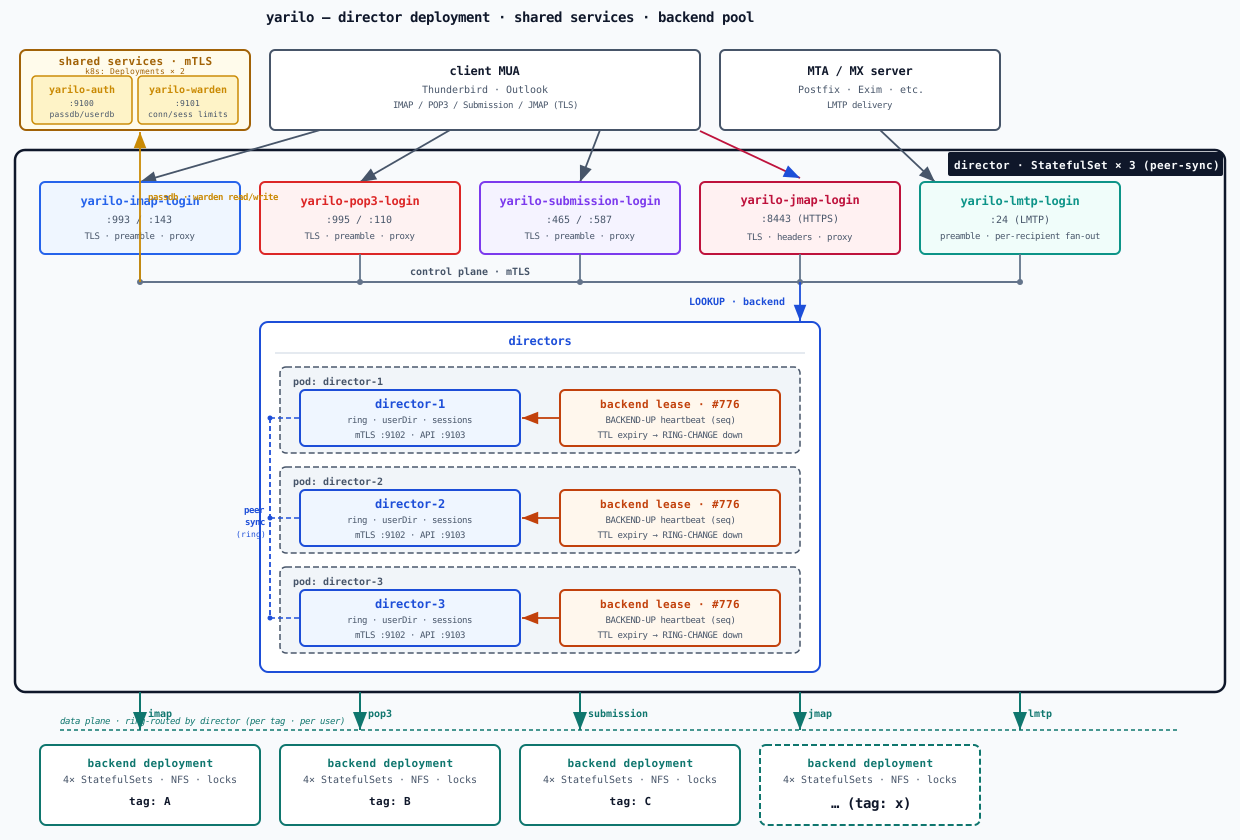
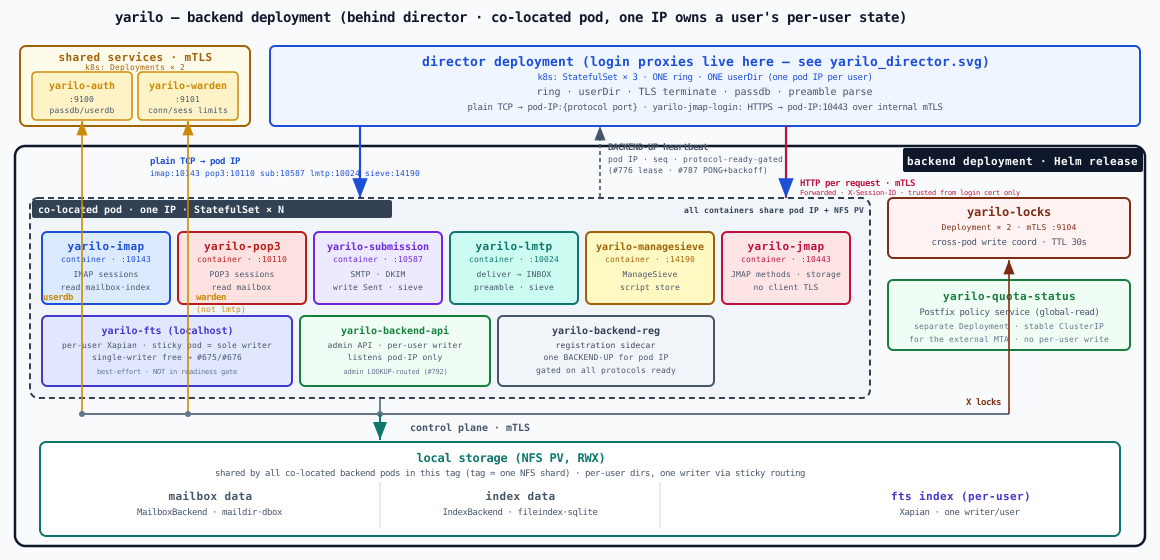
This section uses the sandbox example (helm_values/values-sandbox.yaml, a single-node microk8s namespace yarilo-sb). Production notes are called out inline.
What you'll end up with
| Component | Kind | Purpose |
|---|---|---|
yarilo-director | StatefulSet | LMTP proxy + consistent-hash ring, owns backend routing |
yarilo-backend | StatefulSet | co-located pod: imap / pop3 / submission / lmtp / managesieve + fts + reg sidecar |
yarilo-*-login | Deployments | TLS-terminating login proxies (imap / pop3 / submission / lmtp / managesieve / sasl) |
yarilo-auth | Deployment | passdb + userdb against the SQL store |
yarilo-warden | Deployment | connection accounting, auth-penalty, cross-node kick bus |
yarilo-locks | Deployment | cross-process write coordination (mTLS :9104, Redis-backed) |
yarilo-quota-status | Deployment | RCPT-time quota policy service for a fronting MTA |
| SQL StatefulSet | StatefulSet | passdb / userdb store (sandbox only — use managed SQL in production) |
yarilo-tls Secret | Secret | TLS certificate provisioned by cert-manager |
| LoadBalancer Services | Service | public entry per login proxy (143/993, 110/995, 587/465, 4190, 24) |
Prerequisites
DNS
An A (or AAAA) record for the public hostname pointing at the LoadBalancer IP your cluster will assign:
mail.example.com A <LB-IP>::: note For real mail you also need MX, SPF/TXT, DKIM and PTR records. For the sandbox an A record is enough — the smoke test connects by hostname. :::
cert-manager
helm repo add jetstack https://charts.jetstack.io
helm repo update
helm install cert-manager jetstack/cert-manager \
  --namespace cert-manager --create-namespace \
  --version v1.16.x \
  --set installCRDs=true
kubectl -n cert-manager get pods
All cert-manager pods should report Running before you continue.
ClusterIssuer
The repo ships deploy/clusterissuer.yaml with two solvers: http01 (nginx ingress) and dns01 (Cloudflare, used for mail since no port 80 is needed).
Edit it — replace [email protected] / example.com — then apply:
kubectl -n cert-manager create secret generic cloudflare-api-token \
  --from-literal=api-token=<CLOUDFLARE-API-TOKEN>
kubectl apply -f deploy/clusterissuer.yaml
kubectl get clusterissuer letsencrypt-prod
The ClusterIssuer should report STATUS: Ready.
LoadBalancer support
The chart provisions Service objects of type LoadBalancer. Ensure a controller can fulfil them:
- microk8s —
microk8s enable metallband assign an IP range - k3s — bundled
klipper-lbworks out of the box - EKS / GKE / AKS — the cloud LB controller handles it automatically
Setting up the passdb / userdb store
yarilo-auth resolves logins from a SQL store. Two sandbox manifests ship: MySQL is the default wired by values-sandbox.yaml; Postgres is an alternative.
Both put login (passdb) and storage/quota/routing (userdb) in the same store. The split into passdb_sql_query / userdb_sql_query / userdb_sql_iterate_query lives in values-sandbox.yaml, so migrating to a production layout only changes the queries.
Production
Swap the sandbox manifest for a managed SQL DSN: replace the dsn key in the Secret and run the init SQL against the managed instance. The Secret reference in values-sandbox.yaml stays the same.
MySQL (default)
helm_values/mysql-sandbox.yaml creates namespace db, a mysql Secret (DB yarilo, user yarilo / sandbox-secret), an init ConfigMap and a MySQL 8.4 StatefulSet. The schema is the PostfixAdmin layout: domain, alias and mailbox tables.
kubectl apply -f helm_values/mysql-sandbox.yaml
kubectl -n db get pods,svc,pvc
The mailbox table is what values-sandbox.yaml queries — columns are matched by name, password is the only required one, active maps to enabled. Its DSN reaches yarilo-auth through the YARILO_DB_DSN env var, injected from the mysql Secret; skip_schema: true keeps yarilo-auth from creating its own table.
Seed a user — domain + mailbox + alias rows:
kubectl -n db exec -i mysql-0 -- mysql -uyarilo -psandbox-secret yarilo <<'SQL'
INSERT IGNORE INTO domain (domain, transport, customer_id, active)
VALUES ('mail.example.com', 'virtual', 'cust-0001', 1);

INSERT IGNORE INTO mailbox
  (username, password, mbtype, home, mpath, maildir, local_part, domain, active)
VALUES
  ('[email protected]', '{BCRYPT}REPLACE_WITH_HASH', 'mdbox',
   '/var/mail/vhosts/', 'mail.example.com/[email protected]', 'mdbox',
   'alice', 'mail.example.com', 1);

INSERT IGNORE INTO alias (address, goto, domain, active)
VALUES ('[email protected]', '[email protected]', 'mail.example.com', 1);
SQL
Generate the hash with htpasswd -nbB alice '<password>' | cut -d: -f2 and prefix it with {BCRYPT}.
Postgres (alternative)
helm_values/postgres-sandbox.yaml creates a yarilo-postgres StatefulSet (PG 16, user yarilo / sandbox-secret) with a single users table covering passdb (username / password / active) and userdb (home / mail_path / quota / allow_nets / director_tag).
kubectl apply -f helm_values/postgres-sandbox.yaml
kubectl -n yarilo-sb get pods,svc,pvc
To use Postgres instead of MySQL, point yarilo-auth at this store and switch the passdb block in values-sandbox.yaml to driver: postgres with the users-table queries. The postgres-sandbox.yaml header documents the columns and the expected passdb_sql_query / userdb_sql_query / userdb_sql_iterate_query.
Seed a user:
kubectl -n yarilo-sb exec -i yarilo-postgres-0 -- \
  psql -U yarilo -d yarilo -c \
  "INSERT INTO users (username, password, active, display_name)
   VALUES (LOWER('[email protected]'), '{BCRYPT}REPLACE_WITH_HASH', TRUE, 'Alice');"
With home / mail_path left blank, yarilo derives the path from storage.mailHomeTemplate (%d/%n → <maildirRoot>/<domain>/<local-part>). Set home to an absolute path to override per user.
Deploying yarilo
helm upgrade --install yarilo ./helm \
  -f helm_values/values-sandbox.yaml \
  -n yarilo-sb
Listeners brought up, via the login-proxy LoadBalancer Services:
| Listener | Port | TLS mode |
|---|---|---|
| IMAPS / IMAP | 993 / 143 | implicit TLS / STARTTLS |
| Submissions / Submission | 465 / 587 | implicit TLS / STARTTLS |
| POP3S / POP3 | 995 / 110 | implicit TLS / STARTTLS |
| LMTP | 24 | plain (internal — front it with an MTA) |
| Telemetry | 8080 | ClusterIP only — /healthz, /readyz, /metrics |
Waiting for the certificate
cert-manager creates a Certificate, runs the DNS01 challenge, and writes the result into the yarilo-tls Secret mounted by the login proxies. No restart is needed once it is populated.
kubectl -n yarilo-sb get certificate yarilo-tls -wWait for READY=True; first issuance typically takes 1–3 minutes. If it hangs:
kubectl -n yarilo-sb describe certificate yarilo-tlsGetting the LoadBalancer IP
Each login proxy has its own LoadBalancer Service; the IMAP one is the usual public entry.
kubectl -n yarilo-sb get svc yarilo-imap-login -w
dig +short mail.example.com
Wait for EXTERNAL-IP, then confirm DNS resolves to it.
Running the smoke test
app/smoketest-e2e drives the full flow: Submission AUTH, LMTP delivery, IMAPS LOGIN + SASL, POP3S. From the repo, against the public host:
go run ./app/smoketest-e2e/ \
  -host mail.example.com \
  -user [email protected] \
  -pass '<password>' \
  -submission-port 587 -lmtp-port 24 -imaps-port 993 -pop3s-port 995
For an in-cluster protocol/sieve check, the yarilo-smoketest binary runs as a Job against the login-proxy Services — see hack/smoketest/job.yaml.
Troubleshooting
| Symptom | Likely cause | Fix |
|---|---|---|
Certificate stuck Issuing | Cloudflare API token missing/expired | kubectl -n cert-manager describe order …; recreate cloudflare-api-token |
| login pod CrashLoopBackOff at startup | YARILO_DB_DSN resolves empty | check the SQL Secret's dsn key is populated and base64-encoded |
LoadBalancer stuck <pending> | no LB controller / metallb not enabled | enable metallb or set service.type=NodePort for the sandbox |
Smoke test tls: handshake failure | DNS not yet at the LB, or cert still issuing | dig the host, kubectl get certificate, wait |
| AUTH fails for the seeded user | wrong table/column or missing {SCHEME} prefix | MySQL: mailbox row has active=1; Postgres: users row has active=TRUE; verify the {BCRYPT} prefix |
There is no single yarilo Deployment — read logs per component:
kubectl -n yarilo-sb logs deploy/yarilo-imap-login --tail=200 -f
kubectl -n yarilo-sb logs deploy/yarilo-auth --tail=200 -f
LOG_LEVEL=debug is on by default in values-sandbox.yaml.
Uninstalling
helm uninstall yarilo -n yarilo-sb
kubectl delete -f helm_values/mysql-sandbox.yaml
Use postgres-sandbox.yaml in the second command if you deployed Postgres.
WARNING
PVCs (backend maildir, SQL data) are deleted with their namespaces. To keep mail data, take a kubectl cp snapshot first.
Storage layout
Yarilo storage follows the mail_storage pattern: MailboxBackend and IndexBackend are per-process factories; UserMailbox / UserIndex are per-session handles created once after authentication and closed when the session ends. All per-user state — filesystem root, quota, uid/gid — is captured in mailbox.UserInfo at login time.
The global home layout is controlled by two config keys:
storage:
  maildirRoot: /var/mail/vhosts      # prepended to template-derived paths
  mailHomeTemplate: "%d/%n"          # %d=domain, %n=local-part, %u=full email
The default %d/%n gives /var/mail/vhosts/example.com/alice. Use %u for a flat layout, or %n for single-domain setups. Per-user relocation is a DB-only change — populate home — with no code or config change.
See Mailbox Storage for backends (maildir, dbox, mdbox), self-healing and rotation tuning, and Quota for enforcement.